TL;DR & Key Takeaways
Every AI search engine represents your brand using one of two memory systems: parametric memory (frozen training data) or retrieval (live web search). ChatGPT enables web search on just 34.5% of queries, meaning most answers come from stale training data. Perplexity and Google AI Overviews always retrieve fresh content. These two systems require different fixes, and a single AI visibility score that averages them is misleading. Run a memory posture audit across your key platforms quarterly.
- Audit which AI memory system carries your brand on each platform — citations in the response mean live retrieval fired, while confident answers with no sources came from frozen parametric memory.
- Block Google-Extended only if you intend to restrict Gemini training — it has zero effect on AI Overviews or AI Mode, which are powered by Googlebot and the core Search index.
- Prepare content for query fan-out by answering sub-questions around your topic — Google confirms AI Overviews and AI Mode issue multiple related searches, and each pulls from different pages.
- Fix parametric and retrieval problems separately — training data errors require consistent, corroborated content for the next training cycle, while retrieval gaps need better page structure and third-party corroboration.
- Run a memory posture audit quarterly — Semrush data shows ChatGPT's web search trigger rate dropped from 46% to 34.5% in 17 months, so your visibility shifts even when your content does not change.
The Two Memories That Decide How AI Sees Your Brand
Ask the same question about your brand on ChatGPT and Perplexity, and you will often get two different answers. One cites your latest product page. The other describes a positioning you changed 18 months ago, with no citation at all. Same brand, same question, two representations.
The gap is not random. Every AI engine represents your brand using one of two memory systems, and which system is carrying your brand at any given moment determines whether the answer is fresh or stale, cited or uncited, accurate or wrong.
Understanding this distinction — and learning to audit it — is the difference between guessing at AI visibility and managing it deliberately.
What Is AI Memory Posture?
An AI engine’s memory posture is its default behavior when you ask it a question: does it reach for live web content, or does it answer from knowledge baked into the model during training?
These two systems are fundamentally different.
Parametric memory is the knowledge a model absorbs during training and then holds frozen until its next training run. You cannot edit it by publishing a new page. The only thing that changes it is a new training cycle that ingests updated information.
Retrieval is live web search — the model fetches fresh pages at the moment someone asks a question, similar to how a traditional search engine works.
Every major AI platform leans on one or the other, and some switch between them depending on the query. That leaning is what determines how your brand appears.
The Two Camps: Always-Retrieve vs. Model-Decided
AI search platforms split into two broad groups based on their memory posture.
Always-retrieve engines run a live web search on nearly every question. Perplexity is the clearest example — it retrieves by design and shows its sources as a default behavior, not an exception. Google’s AI Overviews and AI Mode also fall into this camp, but with an important detail: they are served by the same Googlebot crawler that powers organic search results, drawing from Google’s core Search index. Google’s official documentation confirms that AI features are “built into Search and integral to how Search functions.”
Model-decided engines make a judgment call on each individual query: answer from parametric memory, or go fetch from the web. ChatGPT, Claude, Microsoft Copilot, and the Gemini app all fall into this camp. On these engines, whether live retrieval even happens can depend on a setting in someone’s admin console rather than anything you did with your content.
The Model-Decided Problem: When ChatGPT Forgets Your Brand
The model-decided camp is where most brand visibility gaps originate, because retrieval is never guaranteed.
Semrush analyzed more than 1 billion lines of U.S. clickstream data from October 2024 through February 2026 and found that ChatGPT enables its web search feature on just 34.5% of queries as of February 2026 — down from 46% in late 2024. For the majority of questions, ChatGPT answers from parametric memory alone, with no live web search and no citations.
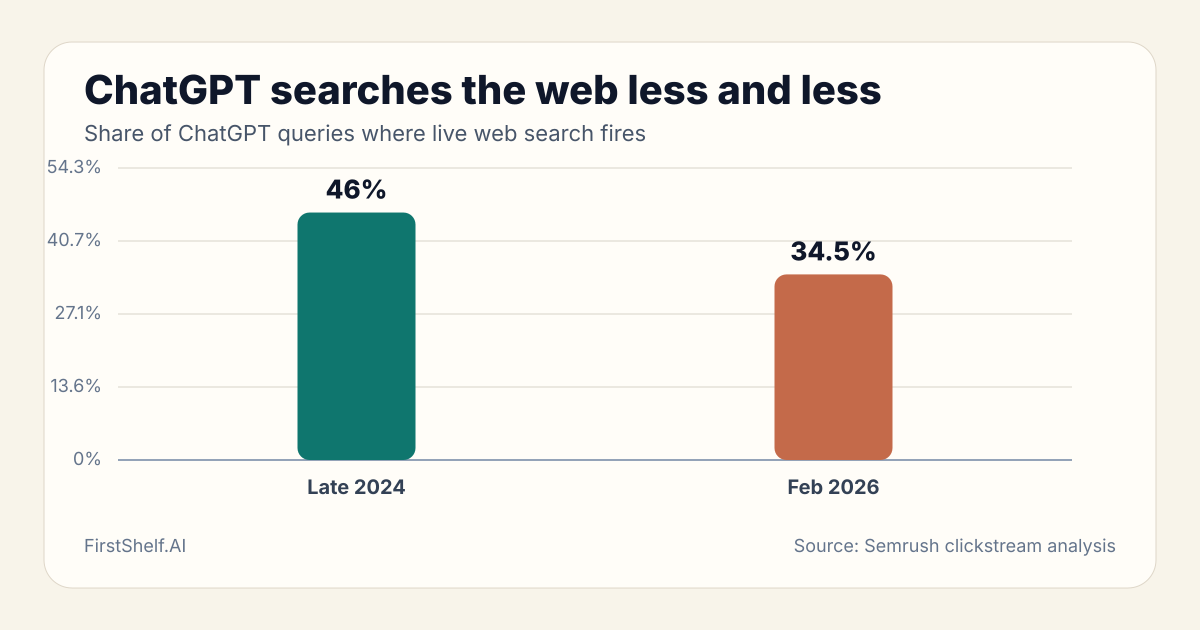
That means if your brand launched a new product, pivoted its positioning, or corrected an error last month, ChatGPT may describe the old version for most queries until its next training cycle ingests the update.
Claude’s web search operates similarly. According to Anthropic’s own API documentation, web search is a tool that the model chooses to invoke when it determines the question needs fresh information — not something that runs on every query.
Microsoft Copilot is even more binary: administrators can toggle web grounding on or off entirely for their organization. When it is off, Copilot falls back to its internal training data with zero web access.
The Google-Extended Trap: A Control That Does Not Do What You Think
Many site owners block the Google-Extended crawler in their robots.txt file, assuming it prevents Google from using their content in AI features. It does not.
Google-Extended is a separate user agent that controls whether your content is used to train Gemini Apps and Vertex AI generative APIs. Google has explicitly clarified that Google-Extended has no effect on Google Search, including AI Overviews and AI Mode. Those features are powered by Googlebot, the same crawler that indexes your pages for organic results.
Blocking Google-Extended does not remove you from AI Overviews. It does, however, prevent your content from being included in Gemini’s parametric memory during future training runs — which means you give up influence over the model-decided layer while remaining fully exposed on the retrieval layer.
For brands optimizing for AI visibility, the practical takeaway is to allow both Googlebot and Google-Extended unless you have a specific, strategic reason to restrict training access. Blocking one thinking it blocks the other is a category error.
Why Retrieval Is Not One Search Anymore
Even when an engine does retrieve, getting cited is no longer a single-step process. Modern AI search uses query fan-out — a technique where one question from the user becomes many sub-queries the system runs on their behalf.
Google’s own documentation confirms that both AI Overviews and AI Mode “may use a query fan-out technique — issuing multiple related searches across subtopics and data sources — to develop a response.”
This means you are no longer optimizing only for the question the user typed. You are optimizing for a constellation of invisible sub-questions the engine generates behind the scenes. A user asking about the best accounting software for freelancers might trigger sub-queries about pricing, integrations, reviews, alternatives, and tax features — and each sub-query can pull from different pages.
If your content only addresses the primary query but not the sub-questions, you lose citation surface area even when the engine is actively retrieving from the web.
The Memory Posture Audit: A Practical Workflow
You can run this audit today with no special tools. The goal is to determine, for each platform that matters to your business, which memory system is carrying your brand — and whether that is the layer you would have chosen on purpose.
Step 1: Pick the queries that matter. Choose five to ten revenue-critical questions: category queries, comparison queries, and problem-framed queries where you need to appear. Skip vanity queries like your brand name alone.
Step 2: Run each query across multiple engines. Test on at least one always-retrieve engine (Perplexity) and at least two model-decided engines (ChatGPT, Claude). Use identical wording every time so the only variable is the platform.
Step 3: Read the posture, not just the answer. Citations are the tell. If the response includes cited source links, retrieval fired. If the response is confident but has no sources, it came from parametric memory. On model-decided engines, try each query twice — once in evergreen phrasing and once with a recency cue like “latest” or “current.” If the second version flips the engine into retrieval mode, that flip reveals the posture boundary.
Step 4: Sort problems by which memory produced them. A stale description with no citations points to a parametric problem — the model learned an outdated version of your story and has not retrained. Being absent entirely, or represented through a competitor’s page on an engine that clearly did retrieve, points to a retrieval-selection problem.
Step 5: Date it and repeat. Memory posture is not stable. Semrush’s data shows ChatGPT’s search-trigger rate fluctuated significantly across the 17-month study window as models were updated. Run this audit quarterly at minimum.
How to Fix Each Layer — Because the Fixes Do Not Transfer
Once you know which memory system is failing you, the fix is different for each.
For parametric problems, you cannot directly edit what a model already holds. But models learn the version of a fact that shows up consistently and corroborated across many sources. Your job is to make the accurate version of your brand story the redundant one — the version that is impossible to miss when crawlers come through for the next training run. This means getting consistent descriptions, accurate third-party coverage, and crawlable entity data in place now, so the correct story is the one that gets learned on the next training cycle.
For retrieval problems, the work is findability and selection. Answer the fan-out sub-questions directly on your pages. Structure content in clean, extractable passages. Strengthen corroboration across third-party sources so your version is the one the engine assembles into its answer. Ensure structured data matches your visible text and that your pages are fully crawlable.
The critical mistake is treating both problems as the same problem. Publishing a corrected page does nothing for a parametric memory error today — but it is the right investment for the next training window. And optimizing for retrieval does not fix what is baked into the model’s parameters.
Why a Single AI Visibility Score Misses the Point
Many tools collapse parametric standing and retrieval standing into one composite score. But these two systems move independently, respond to different optimization work, and fail in different ways.
A brand can rank well in Perplexity’s live retrieval and still be misrepresented in ChatGPT’s parametric memory. A single number that averages those two realities tells you nothing actionable — it flattens two distinct problems into one meaningless figure.
The literacy that matters now is the ability to hold the two layers apart and ask, every time you check an AI platform: which memory is carrying my brand here, and is that the one I would have chosen?
How FirstShelf can help
A memory posture audit tells you where each engine’s picture of your brand comes from — but fixing the retrieval side still comes down to whether your listings are worth selecting when a search does fire. The free FirstShelf GEO audit scores your listings on the signals retrieval systems select for: semantic density, structure quality, and entity authority, the same attributes that decide whether an always-retrieve engine like Perplexity picks your page or a competitor’s.
For the parametric side, consistency is what slowly reshapes a model’s memory between training runs. FirstShelf’s listing rewriting keeps your positioning, attributes, and claims consistent across every page an engine might ingest, and the dashboard tracks your visibility engine by engine instead of hiding the differences behind a single averaged score. Run a free audit at firstshelf.ai to see where your retrieval layer stands.
See how each AI engine represents your brand
FirstShelf tracks your visibility engine by engine — because a single averaged AI score hides exactly the differences that matter.
Run a Free AuditFrequently Asked Questions
What is AI memory posture?
AI memory posture describes whether a given AI engine answers from parametric memory (training data frozen until the next training run) or from live web retrieval. Perplexity and Google AI Overviews retrieve on nearly every query. ChatGPT, Claude, and Microsoft Copilot decide per query whether to search the web or answer from memory, which is why your brand can look different across platforms.
Does blocking Google-Extended remove my site from AI Overviews?
No. Google-Extended only controls whether your content is used to train Gemini Apps and Vertex AI generative APIs. Google has confirmed it has no effect on Google Search, including AI Overviews and AI Mode. Those features are powered by Googlebot, the same crawler that indexes your pages for organic results.
Why does ChatGPT describe my brand differently than Perplexity?
ChatGPT enables its web search on just 34.5% of queries as of February 2026, according to Semrush's analysis of over 1 billion lines of clickstream data. For the majority of questions, it answers from training data that may be months old. Perplexity retrieves live web content on nearly every query, so it cites your current pages. The gap is structural, not random.
How often should I audit my AI memory posture?
At least quarterly. Memory posture is not stable — Semrush found ChatGPT's search-trigger rate fluctuated significantly across an 18-month study window as underlying models were updated. A one-time audit is a snapshot, not a lasting finding. Date each audit and compare results over time to catch posture shifts before they affect your visibility.
Glossary
- Memory Posture
- An AI engine's default behavior when answering a question: whether it reaches for live web retrieval or answers from knowledge baked into the model during training. Determines whether your brand appears fresh or stale in AI answers.
- Parametric Memory
- Knowledge a large language model absorbs during training and holds frozen until its next training run. It cannot be changed by publishing new content — only by a new training cycle that ingests updated information.
- Retrieval
- Live web search performed by an AI engine at the moment a user asks a question, pulling fresh pages and citing sources, similar to how a traditional search engine works.
- Query Fan-Out
- A technique used by AI search where one user question becomes multiple related sub-queries across different topics and data sources, each potentially pulling from different web pages.
- Google-Extended
- A Google user agent that controls whether website content is used to train Gemini Apps and Vertex AI generative APIs. It does not affect Google Search, AI Overviews, or AI Mode.
Sources
- Google Search Central — AI Features and Your Website - Official Google documentation on how AI Overviews and AI Mode work, the query fan-out technique, and confirmation that Googlebot controls crawling for AI features in Search.
- Semrush — ChatGPT Traffic Analysis: Insights from 17 Months of Clickstream Data - Analysis of over 1 billion lines of U.S. clickstream data (Oct 2024 – Feb 2026) showing ChatGPT enables web search on 34.5% of queries, down from 46%, and referral traffic grew 206% in 2025.
- Search Engine Journal — AI Search Runs On Two Memory Systems - Duane Forrester's framework for AI memory posture, introducing the always-retrieve vs. model-decided distinction and a practical five-step audit workflow.
- Search Engine Journal — Google Clarifies the Google-Extended Crawler Documentation - Confirms Google-Extended only affects Gemini Apps and Vertex AI training data, and explicitly has no effect on Google Search, AI Overviews, or AI Mode.
- Anthropic — Web Search Tool (Claude API Docs) - Official documentation showing Claude's web search operates as an optional tool the model chooses to invoke per query, not a default on every prompt.
- Microsoft Learn — Web Search in Microsoft 365 Copilot - Confirms Copilot's web search is an optional feature that administrators can toggle on or off, with fallback to internal training data when disabled.
Related Articles
ChatGPT vs Perplexity Citation Strategy
ChatGPT and Perplexity disclose different crawler controls, but not the simplistic backends often claimed. Here is what sellers can verify, test, and optimize.
5 min readAgent Readiness Scores: What Actually Matters
Cloudflare's Agent Readiness Scanner scores websites on 16 signals across 5 categories. But the composite number is misleading. Here's what actually matters for making your site legible to AI agents — and what Google says you can skip.
8 min read