TL;DR & Key Takeaways
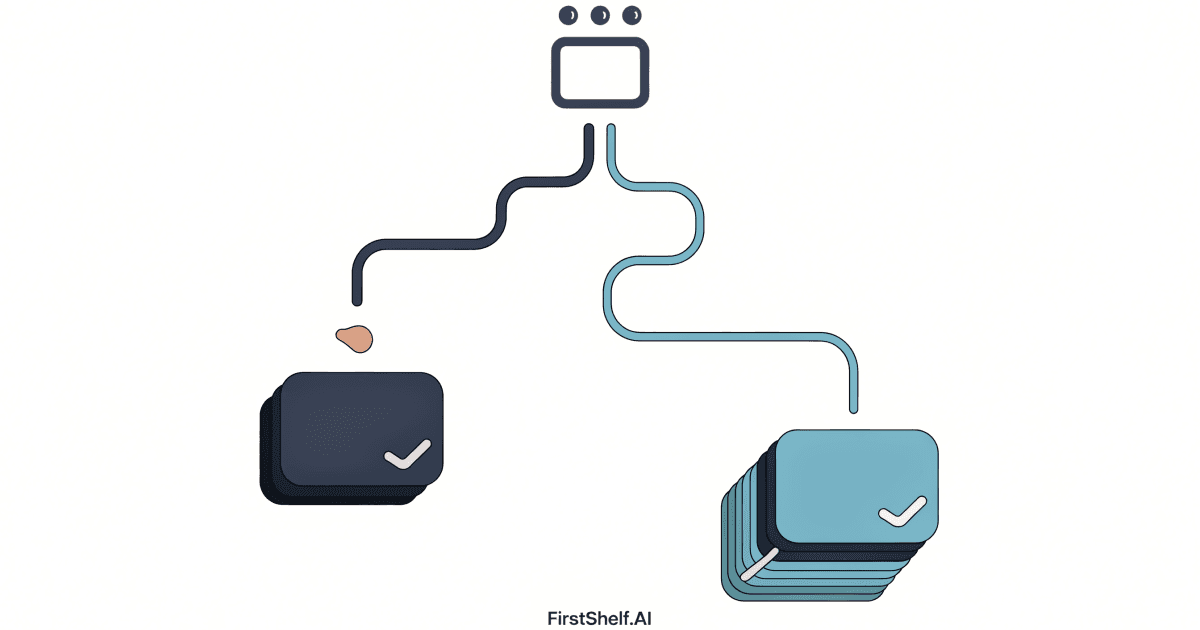
ChatGPT's high-reasoning “Thinking” mode shares only 25.6% of its cited sources with the default quick-answer mode, according to a Semrush and Kevin Indig study of 200 responses across 20 buyer journeys. When a buyer asks a complex comparison question, ChatGPT automatically switches to deeper research — running nearly five times more web searches and favoring documentation, support pages, and primary data over Reddit. Brands winning quick answers can vanish when buyers ask the harder questions.
- Track your ChatGPT visibility separately for simple questions and complex comparisons — a Semrush and Kevin Indig study found only 25.6% of cited domains overlap between quick-answer mode and high-reasoning Thinking mode.
- Build documentation-style reference pages for every product — official docs and support pages grew from 12.4% to 17.5% of ChatGPT citations in Thinking mode, while Reddit fell from 15% to 7%.
- Cover every sub-question a comparison triggers — high-reasoning mode runs 24 sub-queries per comparison prompt versus 5.5 for quick answers, and the brand cited across the most sub-searches wins.
- Publish primary data and structured claims — government and academic sources quadrupled from 1.9% to 8.8% of citations in Thinking mode, so original research and explicit stats get pulled in.
- Invest in early-funnel content because high reasoning carries brands through the full journey — brands cited at the problem stage survived to selection in 4 of 20 journeys, versus zero in quick mode.
Most sellers treat ChatGPT as one search engine. It is not. ChatGPT has two distinct response modes — a fast “Instant” mode and a deeper “Thinking” mode — and they cite completely different brands. A June 2026 study by Semrush and growth advisor Kevin Indig found that only 25.6% of cited domains overlap between the two. When a buyer asks a complex comparison question, ChatGPT automatically switches to Thinking mode and re-researches the topic from scratch. The brand that won the quick answer is not guaranteed to win the considered one.
What changed: Thinking mode is a second search surface
ChatGPT’s Instant mode is the default fast-answer experience. Thinking mode is the deeper, multi-step research mode designed for complex questions. You do not have to switch manually — ChatGPT routes comparison questions, regulatory questions, and multi-criteria evaluations into high-reasoning mode on its own, including for free-tier users.
That routing matters because the two modes behave like separate search engines. Semrush ran 100 prompts through GPT-5.2 twice, once in minimal reasoning and once in high reasoning, producing 200 total responses across 20 buyer journeys in B2B SaaS, finance, consumer tech, and health and lifestyle.
The gap between modes is not small. High-reasoning mode pulled from 173 unique domains across the test set versus 127 for minimal reasoning, and 99 of those high-reasoning domains never appeared in minimal reasoning at all. If you only track your visibility in default answers, you are blind to nearly half the sources Thinking mode evaluates.
The numbers behind the split
When reasoning turns on, ChatGPT does substantially more research before it answers:
- Citation rate climbs from 50% in quick mode to 68% in Thinking mode — 18 percentage points more answers cite an external source.
- Sources per response nearly double, from 2.6 to 4.5.
- High reasoning ran 1,130 web searches across the test set versus 245 for minimal reasoning — nearly five times more.
- The same domain appeared multiple times within a single answer in 51 of 100 Thinking-mode responses, versus 26 of 100 in quick mode.
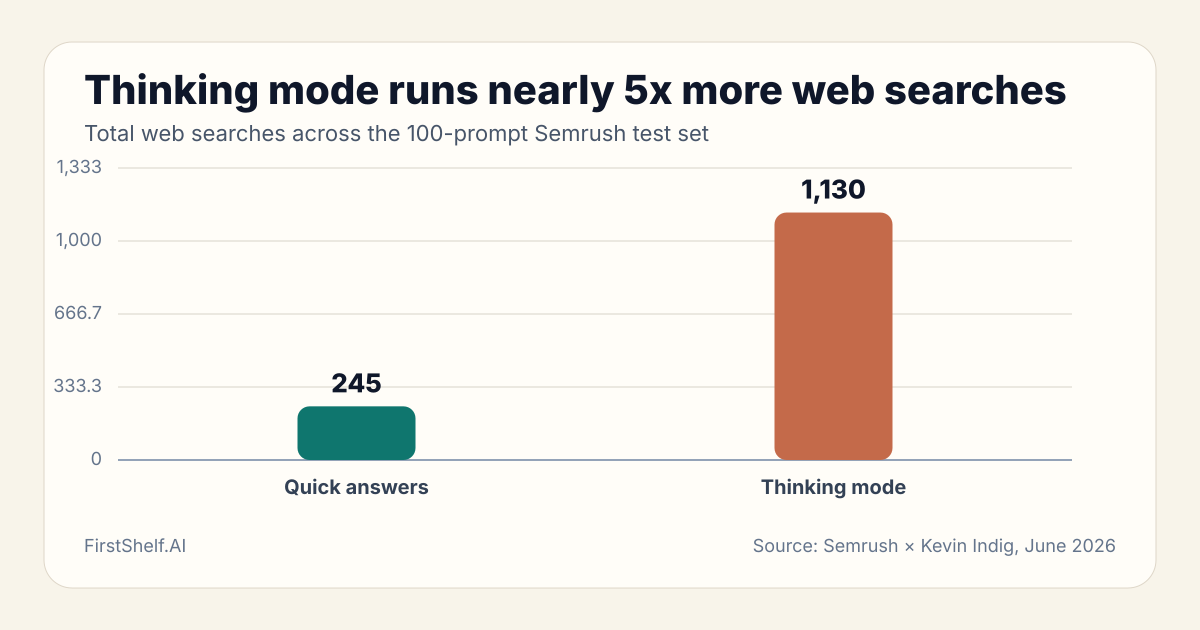
More research does not mean longer answers. Thinking-mode responses were only slightly longer than quick-mode ones. The model packs more cited evidence into roughly the same length of output, which means every citation it pulls has to be clean, specific, and self-contained enough to stand on its own.
Why your Reddit strategy stops working in Thinking mode
The source mix shifts hard when reasoning increases. Reddit’s citation share fell from 15% in quick mode to 7% in Thinking mode. User-generated content and review sites dropped from 14.3% to 6%.
What rose instead:
- Official documentation and support pages grew from 12.4% to 17.5%.
- Government and academic sources quadrupled, from 1.9% to 8.8%.
Brands themselves appeared almost equally in both modes (62.4% in quick mode versus 60.6% in Thinking mode), so you are not less visible as a brand — but the corroborating evidence around you changes. If most of your current AI citations come from Reddit threads and review aggregators, you are winning the quick answer and losing the considered one.
The practical implication: to stay visible in Thinking mode, invest in the source types it actually pulls from. That means owning more official product documentation on your own site, publishing original data that experts and writers can cite, and earning references in authoritative third-party sources.
Comparison questions trigger Thinking mode automatically
The mode gap is not constant across the buyer journey. It spikes exactly where decisions happen.
At the Problem stage — when a buyer recognizes a need — Thinking mode’s citation rate was 35 percentage points higher than quick mode. By the Validation stage, the gap shrinks to 5 points. The biggest divergence is early, and at comparison.
The Comparison stage is where high reasoning does its most research: 24 sub-queries per prompt versus 5.5 for quick mode, and average citations peak at 9.8 per response versus 5.8. When a buyer asks “brand A vs brand B vs brand C for my situation,” Thinking mode breaks the question into roughly eight sub-searches — pricing tiers, integrations, materials, security, support, documentation — and runs a separate search for each one.
The brand that wins is not the one that ranks for the original prompt. It is the one with pages showing up clearly across the most sub-searches. A single product page is not enough; you need citable answers spread across the specific attributes a comparison will decompose.
How to make your listings citable in Thinking mode
Five concrete steps, drawn from what the data shows high reasoning rewards:
1. Build a documentation page for every product. Official docs and support pages grew their citation share the most. For each listing, create a reference page that covers specifications, materials, sizing, compatibility, warranty, and care — the exact sub-attributes a comparison query decomposes into. Make each section self-contained so it can be pulled as a single citation.
2. Make every claim explicit and named. High reasoning pulls individual passages into sub-query responses. Name your product, state your stats in plain figures, and put each claim in its own sentence. A line like “the copper core conducts heat 23% faster than standard aluminum” is citable; “great heat conductivity” is not.
3. Cover the full comparison sub-query set. Write down the eight to ten questions a comparison of your product would trigger — price, materials, durability, fit, reviews, alternatives, warranty, shipping. Make sure you have a clear, citable answer for each one on its own URL or a clearly labeled section.
4. Earn authoritative third-party references. Government, academic, and trade-association sources quadrupled their citation share in Thinking mode. Original research, expert contributions, and data partnerships give the model the kind of corroborating source it now prefers over social proof.
5. Publish primary data. Original benchmarks, test results, and proprietary statistics give writers and the model something concrete to cite. Thinking mode favors sources with explicit numbers and structured claims over generic marketing copy.
Map the buyer journey across both modes
High reasoning changes how brands persist across a conversation. In the Semrush study, a brand cited at the Problem stage survived all the way to the Selection stage in 4 of 20 journeys under Thinking mode — and in zero journeys under quick mode.
That means early-funnel content compounds in high reasoning. A buyer who sees you in their first exploratory question is more likely to keep seeing you through comparison and selection, but only if the model encountered you early. Treat your top-of-funnel educational content as a citation source, not just brand awareness. Name your product and methodology explicitly so the model has something to attribute when it surfaces those pages.
To find your own gaps, run your buyer journey: write the question a buyer asks at each of the five stages (Problem, Exploration, Comparison, Validation, Selection), then ask each one in ChatGPT with Thinking mode on. Note where your brand appears and where it drops out. The stages where you disappear are your highest-leverage content gaps.
How FirstShelf can help
Thinking mode rewards listings that are structured into clean, citable claims — and that is exactly what the FirstShelf Score measures. The free GEO audit scores your listings on semantic density (whether your claims are explicit and named), structure quality (whether each attribute is self-contained and extractable), and entity authority (whether the corroboration around your brand is consistent). These are the same signals that decide whether your pages survive a comparison’s sub-searches.
Run a free FirstShelf GEO audit at firstshelf.ai to see where your listings stand on these signals, then use the listing rewriting tool to turn feature bullets into the documentation-style passages Thinking mode pulls into its answers.
See how your listings score before the harder questions come
FirstShelf scores semantic density, structure quality, and entity authority — the signals Thinking mode's sub-searches filter on.
Check My Listing ScoreFrequently Asked Questions
What is ChatGPT Thinking mode?
Thinking mode is ChatGPT's high-reasoning setting, designed for complex, multi-step questions. It runs more web searches and breaks a question into many sub-queries before answering. ChatGPT routes comparison and evaluation questions into Thinking mode automatically, even for free users, so your visibility depends on it.
Does ChatGPT cite the same sources in Thinking and quick mode?
No. A Semrush and Kevin Indig study found only 25.6% of cited domains overlap between the two modes. Nearly three in four cited sources differ, and the source types shift toward documentation, support pages, and primary data when reasoning increases.
Should I stop investing in Reddit for AI visibility?
Not entirely. Reddit and review sites remain strong in quick-answer mode. But their citation share roughly halves when high reasoning turns on, so balance them with official documentation, original research, and authoritative third-party references that Thinking mode prefers.
How do I know if buyers are using Thinking mode for my products?
Comparison and decision questions trigger high reasoning automatically. If your customers ask “which X is best for Y” or “brand A vs brand B” questions, they are in Thinking mode. Audit those specific prompts with Thinking turned on to see where you appear and where you drop out.
Glossary
- Reasoning mode
- The depth of deliberation a model applies before answering. ChatGPT's quick Instant mode answers fast with minimal reasoning, while Thinking mode breaks a question into many sub-searches for complex queries. The two modes cite different brands.
- Fan-out queries
- The internal sub-queries a model runs to research a prompt before answering. High-reasoning mode runs 4.6x more of them, which means more pages get evaluated before a citation is chosen.
- Reasoning lift
- A term coined by growth advisor Kevin Indig for the gap in which brands and sources appear when a model switches from minimal to high reasoning on the same prompt.
- Citation rate
- The share of AI responses that cite at least one external source. In the Semrush study it rose from 50% in quick mode to 68% in Thinking mode.
Sources
- Semrush — Only 25% of cited sources overlap between ChatGPT's different reasoning modes [Study] - Primary research by Semrush and growth advisor Kevin Indig. Tested 100 prompts through GPT-5.2 in minimal and high reasoning (200 responses) across 20 buyer journeys in B2B SaaS, finance, consumer tech, and health and lifestyle.
- Search Engine Land — ChatGPT Thinking mode changes which brands get cited - Danny Goodwin's July 1, 2026 analysis of the Semrush and Kevin Indig reasoning-mode study, including the 25.6% overlap figure and source-type shifts.
Related Articles
Product Images for AI Search: Visual SEO
Review one product gallery for buyer questions, accurate alt text, variant consistency, and image access. Includes an illustrative T-shirt photo plan and an evidence log.
6 min readCited vs. Recommended: The New AI Search Authority Gap
Google's AI cites your content but recommends your competitor 69% of the time. A newly analyzed Google patent reveals how AI builds entity profiles — and why brand authority, not citation count, now determines who gets recommended in AI search.
7 min read