Back to Blog
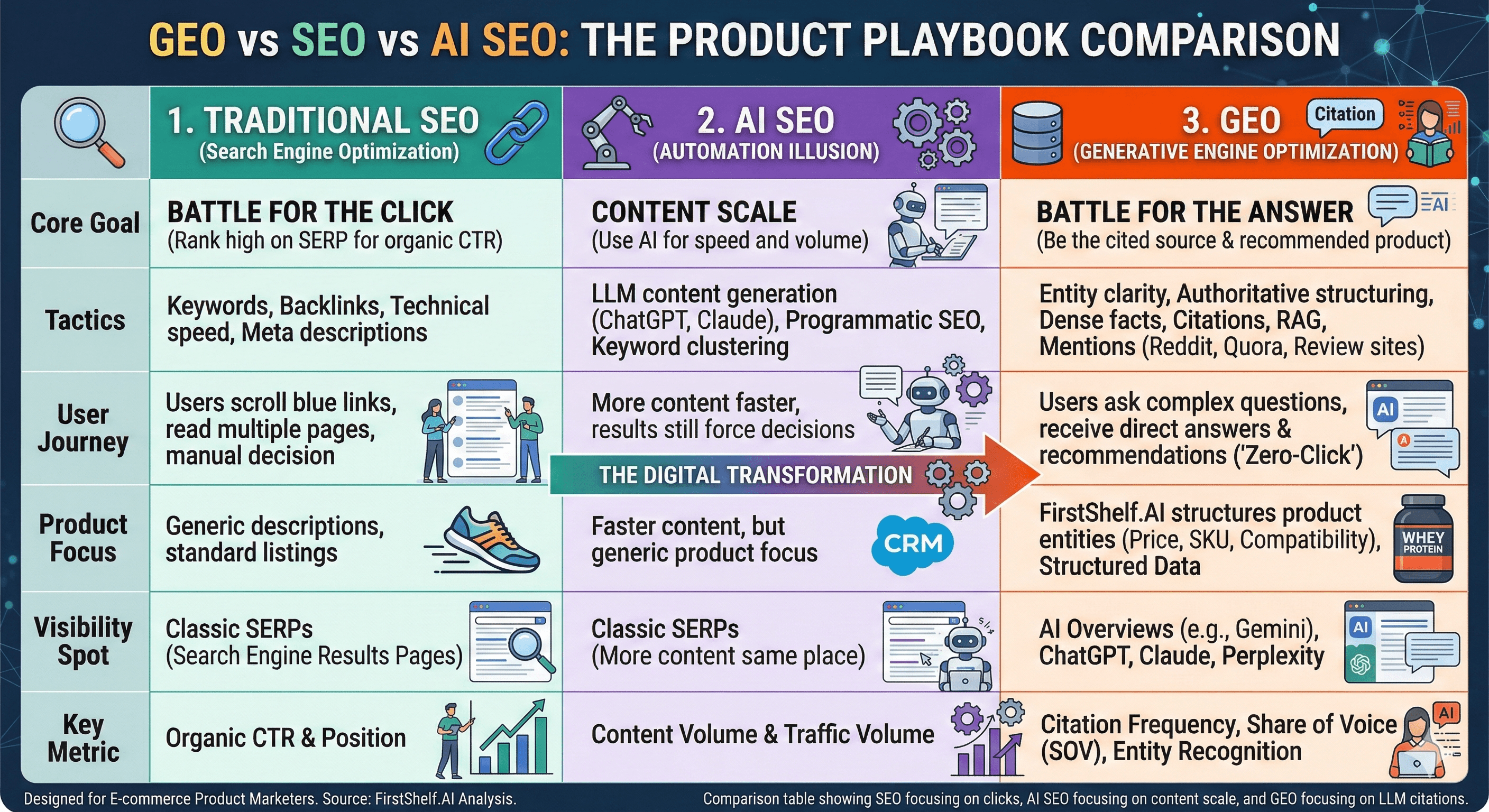
Diagram comparing three search marketing workflows. Left: Traditional SEO funnel focused on ranking for SERP clicks. Middle: AI SEO automating keyword and content generation. Right: Generative Engine Optimization (GEO) using structured data and entity recognition to secure LLM citations and product recommendations in zero-click searches.
AI Search StrategyIntermediate

GEO vs SEO vs AI SEO: The Product Playbook

Search is shifting from clicking links to getting direct answers. Discover the critical differences between GEO, SEO, and AI SEO, and why optimizing for AI engines is the ultimate strategy for product visibility.

·
4 min read
·
BBobby
TL;DR:

Traditional search relies on winning the click, but the future of product discovery relies on winning the answer. While SEO drives traffic to links and AI SEO accelerates content creation, Generative Engine Optimization (GEO) ensures your product is the cited recommendation in AI-generated answers.

Key Takeaways:
  • SEO is for links; GEO is for answers: Traditional SEO focuses on SERP rankings, while GEO focuses on entity recognition and LLM citations.
  • AI SEO is a workflow, not an outcome: Using AI to write blogs or find keywords is AI SEO; it still relies on the old "blue link" paradigm.
  • Products need GEO to survive: Consumers now ask AI tools (like ChatGPT or Perplexity) for "best of" lists and product comparisons. If the AI doesn't cite you, you aren't in the consideration set.
  • FirstShelf.AI is the competitive edge: Unlike generic SEO tools, FirstShelf.AI is purpose-built to structure, monitor, and inject product entities directly into the generative AI ecosystem.

Search is undergoing its most radical transformation in decades. We are moving from the era of "information retrieval" to the era of "information synthesis."

For product marketers and e-commerce brands, the stakes have never been higher. Consumers are no longer scrolling through pages of blue links to find the best running shoe, CRM software, or whey protein. They are asking AI assistants—and taking their direct recommendations as gospel.

To survive this shift, you need to understand the distinct differences between GEO, SEO, and AI SEO, and why a product-specific strategy is your only path to the top.

What is Generative Engine Optimization (GEO)?

Generative Engine Optimization (GEO) is the practice of positioning your brand and content so that AI platforms like Google’s AI Overviews, ChatGPT, Claude, and Perplexity cite or recommend you when users ask questions.

While traditional search engines act like a library catalog (pointing you to the right book), generative engines act like an expert librarian (reading the books and giving you the exact answer). GEO is how you ensure the librarian mentions your product.

GEO vs. SEO vs. AI SEO: What’s the Difference?

It is easy to conflate these three terms, but they represent entirely different mechanisms and goals.

1. Traditional SEO: The Battle for the Click

  • The Goal: Rank as high as possible on a Search Engine Results Page (SERP) to earn a click.
  • The Tactics: Keyword density, backlink building, technical site speed, and meta descriptions.
  • The Reality: The user still has to click your link, read your page, and decide if your product fits their needs.

2. AI SEO: The Automation Illusion

  • The Goal: Use AI tools to do traditional SEO faster and at scale.
  • The Tactics: Using ChatGPT to write blog posts, AI tools to cluster keywords, or programmatic SEO to spin up thousands of landing pages.
  • The Reality: AI SEO is a workflow upgrade, not a paradigm shift. You are still playing the "blue link" game, just with faster content production. In fact, relying too heavily on AI SEO can lead to generic content that AI engines actively ignore.

3. GEO: The Battle for the Answer

  • The Goal: Be the cited source and recommended product inside the AI’s generated answer.
  • The Tactics: Entity clarity, authoritative structuring, dense factual points, statistical citations, and third-party mentions (Reddit, Quora, Review sites).
  • The Reality: GEO secures your place in the "zero-click" internet. If an AI blurt solves the user's query and recommends your product, you win the consideration phase instantly.

Why GEO is the Ultimate Strategy for PRODUCTS

When a user searches for a concept, they want to learn. When a user searches for a product, they want to buy.

In the AI era, users input highly specific, multi-layered prompts: "What is the best project management software for a 50-person remote design agency that integrates with Slack and costs under $20/user?"

Traditional SEO struggles with this long-tail complexity. Generative AI thrives on it. It synthesizes reviews, pricing pages, and feature sets to spit out a definitive top 3 list.

If your product content isn't optimized for GEO, you will not be on that list.

Products benefit uniquely from GEO because:

  1. AI relies on structured entities: LLMs look for unambiguous product data (Price, SKUs, Dimensions, Compatibility).
  2. Citations act as endorsements: Being named by Perplexity or ChatGPT functions as a powerful credibility marker.
  3. Downstream traffic is warmer: A user who clicks a citation link from an AI answer already knows your product fits their highly specific criteria. Their intent to purchase is massive.

How FirstShelf.AI Owns the AI Product Shelf

Most current marketing tools are retrofitting their legacy SEO platforms to track AI. They are looking in the rearview mirror.

FirstShelf.AI stands out because it was built natively for the Generative Engine era, specifically engineered for products.

Here is how FirstShelf.AI bridges the gap between your product catalog and the LLM ecosystem:

  • Entity Structuring Engine: LLMs don't just read text; they parse relationships. FirstShelf.AI structures your product descriptions, specs, and use-cases into cleanly formatted, machine-readable entities that models love to extract.
  • Answer-Ready Asset Generation: FirstShelf.AI identifies the "high-stakes" comparison queries your buyers are asking AI, and helps you generate canonical, dense factual assets that survive LLM compression without losing your unique value proposition.
  • Share of Voice (SOV) Monitoring for AI: Traditional rank tracking is dead. FirstShelf.AI monitors citation frequency, competitor placement, and brand sentiment directly across ChatGPT, Perplexity, Gemini, and Claude.
  • Third-Party Signal Aggregation: Because LLMs weigh external mentions heavily, FirstShelf.AI tracks your product's presence on UGC platforms (like Reddit) and review sites, ensuring your off-site footprint aligns with your on-site GEO strategy.

In the AI-first world, there is no Page 2. You are either the answer, or you don't exist. FirstShelf.AI ensures your products are always stocked on the first shelf of the AI mind.

Frequently Asked Questions

Will GEO replace SEO entirely?

No. SEO remains the foundation of discoverability because LLMs still need to crawl traditional web infrastructure to find information. However, GEO is the necessary next layer to ensure that information is synthesized and recommended, not just indexed.

How long does it take to see results from GEO?

Because LLMs continuously scrape the web and update their training data or retrieval-augmented generation (RAG) databases, properly structured GEO updates can influence AI answers in as little as a few weeks, especially for high-authority domains.

Can I just use ChatGPT to write my product pages for GEO?

This is a common AI SEO trap. Using AI to write generic, fluffy content actually hurts your GEO. Generative engines look for dense facts, unique statistics, and clear structure—not marketing filler.

Glossary

Generative Engine Optimization (GEO)
Structuring digital content so generative AI systems cite and recommend your brand in direct answers.
Traditional SEO
Optimizing websites to rank higher on Search Engine Results Pages (SERPs) for organic click-through traffic.
AI SEO
Using artificial intelligence tools to automate and scale traditional SEO tasks, like programmatic content generation.
Share of Voice (SOV) for AI
A metric tracking citation frequency, competitor placement, and brand sentiment directly across LLMs like ChatGPT and Perplexity.