
TL;DR & Key Takeaways
On August 6, 2026, Cloudflare made it near zero-code to publish a search and MCP endpoint over your own content - the missing 'discoverable' pillar of the agent web. Verified live on Cloudflare's ten-domain Dev Stack MCP and matched by Microsoft's Web IQ grounding APIs, agent-facing search endpoints are becoming default plumbing. Etsy and Amazon sellers cannot deploy one, but the attributes that would feed an endpoint are the same fields citations already read - and most catalogs are not ready.
- Publish a read-only /search or /mcp endpoint over your own-domain catalog if you can - Cloudflare AI Search's August 6 update removed the sitemap, hosting, and token-cost barriers in one pass.
- Ask support conversations for your tool list: sizing, compatibility, materials, shipping, and returns questions are the content an agent search endpoint should answer first.
- Marketplace sellers on Etsy and Amazon cannot deploy endpoints - close attribute gaps now so the fields a future platform endpoint reads are complete.
- Verify your own endpoint the way we did: make one live tools/call query and confirm the answer is current, cited, and attributed before telling anyone it exists.
- An endpoint makes you queryable, not recommended - keep measuring citation and recommendation outcomes separately.
For two years, the seller question in AI search has been “will the assistant cite my listing?” That is a question about being found when a human asks. A second, quieter question is forming underneath it: when an agent goes looking on its own, what can it actually query?
On August 6, 2026, that second question got its first practical answer for ordinary site owners. Cloudflare’s AI Search updates — shipped the same week as its AEO visibility tools — let anyone publish a search endpoint over content they control: a /search URL, an MCP tool endpoint, optionally served from their own hostname, created with a single command. An agent that reaches your endpoint no longer has to crawl, render, and read your pages to answer “do you have this in 18x24, framed, and does it ship to Canada?” It asks your corpus directly and gets cited chunks back.
This article covers what actually shipped, the live proof the pattern already works in production, why agents retrieve instead of read, and what marketplace sellers can realistically do this month — including the honest split between sellers who own a domain and sellers inside Etsy or Amazon.
What Cloudflare actually shipped
Cloudflare AI Search is not new. Its crawler was renamed Cloudflare-AI-Search on February 9, 2026, and public endpoints with MCP support arrived March 23, 2026, according to the product’s release notes. What changed on August 6, 2026 is that the path from “I have a website” to “agents can search it” became close to zero-code, in four specific ways.
First, sites no longer need a complete sitemap. A new Discover parsing option starts at your source URL and collects pages from your sitemaps and from the links it finds while crawling, so a catalog with a weak or missing sitemap can still be indexed.
Second, a namespace — a group of AI Search instances — can expose one public endpoint that searches across every instance in it at once. One URL, many sources, merged and ranked results, no authentication required if you choose.
Third, that endpoint can now sit on your own hostname, such as search.example.com/search, and Cloudflare Access can sit in front of it if you want to require authentication before any request reaches your data.
Fourth, Cloudflare published its first pricing preview: embedding and reranking are free when you use default models from the Workers AI catalog, which removes the token-budget guessing that made self-hosted semantic search intimidating for small stores. {{stat:1}}
For a seller with a storefront on their own domain, the whole setup is one command in the Wrangler CLI: npx wrangler ai-search create your-store --source https://your-store.com --type web-crawler --parse-type discover. Cloudflare’s own announcement frames the goal plainly: give your agents their own search engine over your data.
The pattern is already live in production
The clearest proof that agent-facing search endpoints work at real scale is Cloudflare’s own Dev Stack MCP, which any agent can use today. It exposes one tool, search_dev_stack, that fans out across ten Cloudflare-owned surfaces — Developer Docs, Blog, API Docs, Community, Astro, Vite, Vitest, Hono, Replicate, and OpenNext — and returns cited, current chunks tagged with the surface they came from. {{stat:2}}
FirstShelf verified this directly on August 20, 2026: a live tools/call request to stack.mcp.cloudflare.com/mcp with the query “Cloudflare-AI-Search user agent robots.txt policy” returned the current AI Search release-note documentation, correctly attributed, in a single response. The endpoint answered a precise product question without the agent fetching or rendering a single page.
That is the discovery experience your catalog could offer an agent: current, cited, and one call away.
Separate the observation from the inference. The observation: a major infrastructure provider now treats “searchable by agents” as a product primitive and runs a ten-domain production corpus through it. The inference: agent-facing search endpoints are moving from idea to default plumbing, on the same arc sitemaps and RSS feeds followed a decade ago. The inference could be wrong about timing, but the production usage is verifiable today.
Why agents retrieve instead of read
The economics of tokens are the reason this layer exists. Agents pay, in compute and context window, for everything they read. Cloudflare’s Markdown for Agents feature made that cost visible from the publisher side: a site can serve clean markdown through content negotiation — a plain Accept: text/markdown request header — and Cloudflare measured one of its own blog pages at 16,180 tokens in HTML versus 3,150 tokens in markdown, roughly an 80% reduction. FirstShelf re-verified the behavior on August 20, 2026: the Markdown for Agents documentation page returned content-type: text/markdown with an x-markdown-tokens: 4099 header and a content-signal policy header attached. {{chart}}
Search is the next reduction on the same axis. Instead of an agent reading your whole markdown page to find the one paragraph about sizing, it asks for “sizing” and receives that paragraph. Fewer tokens, less latency, fewer chances to misread — and a clean signal back to you about which content agents actually use.
Microsoft is building the same shift from the other end of the wire. On June 2, 2026, Microsoft announced Web IQ, a suite of grounding APIs it describes as “a search engine for AI systems,” re-architected from the Bing index because agents “do not issue a single search and stop” — they retrieve repeatedly, reason over evidence, and operate inside tight latency budgets. Cloudflare on the publisher side and Microsoft on the agent side are now converging on the same architecture: retrieval, not page-fetching, is the agent’s native act.
For sellers, this reframes the practice of GEO for marketplace sellers. Citation work makes you findable when a human asks an assistant. A search endpoint makes you queryable when an agent goes looking on its own. The two layers consume the same underlying asset — structured, complete, accurate product data — so they improve together, but neither substitutes for the other.
What marketplace sellers should actually do
Start by being honest about which kind of seller you are.
If you run a storefront on your own domain — Shopify on a custom domain, WooCommerce, BigCommerce — you can act now. Inventory the questions your customers already ask in support conversations: sizing, compatibility, materials, shipping windows, returns. Those question-and-answer pairs are the highest-value content to make retrievable. Then decide whether to stand up an AI Search instance over your catalog and help pages, or any OpenAI-compatible search API exposed as an MCP endpoint from your own stack — AI Search is the most packaged path today, but the pattern is open. Keep it read-only: query and retrieve, no purchase-mutating actions. Finally, check your crawler posture so the agents you want can actually reach you — the Search, Agent, and Training decisions are now separate switches, as our crawler-split guide explains.
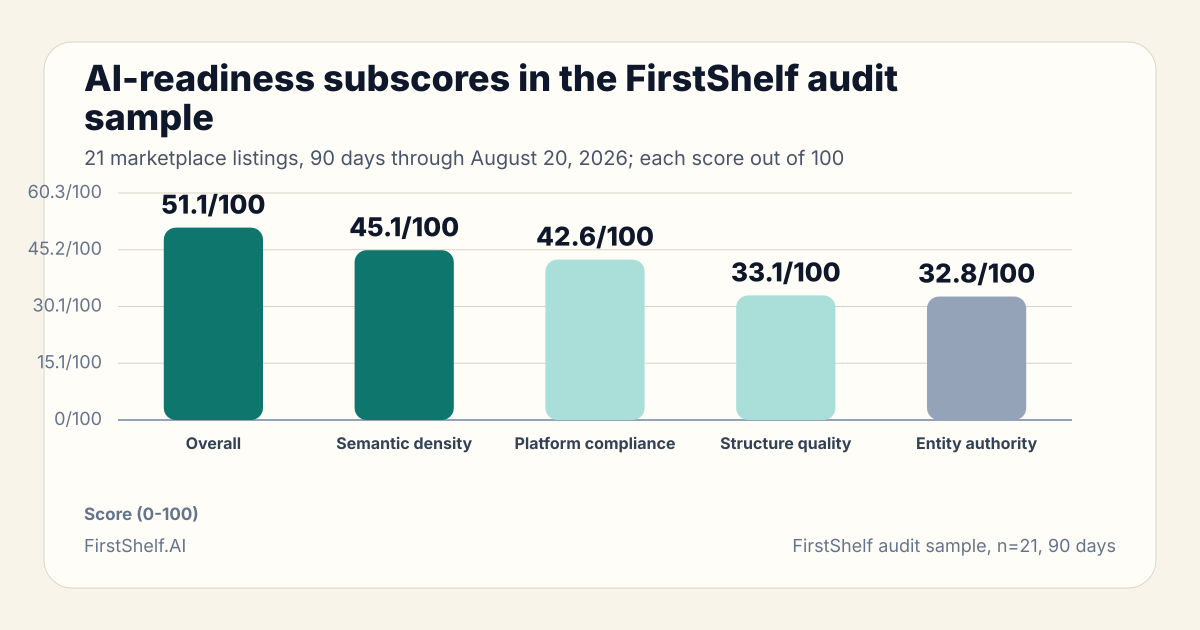
If you sell inside Etsy or Amazon, you cannot deploy an endpoint on a page you do not control — the same platform-mediated posture as our WebMCP analysis. Your move is preparation, because when your platform eventually ships agent-facing search over its catalog, it will index the structured fields that exist. FirstShelf’s own audit sample is the caution here: 21 marketplace listings tracked over 90 days through August 20, 2026 averaged 51.1 out of 100 on AI-readiness, with structure quality at 33.1 and entity authority at 32.8 out of 100. {{stat:3}} The corpus that would feed an agent search endpoint is mostly not retrieval-ready yet. Closing attribute gaps — materials, compatibility, dimensions, license terms, returns — is the preparation work that pays off on both layers. That preparation is the same work we detail for marketplace sellers on Shopify and Etsy.
What an endpoint does not guarantee
An endpoint makes you queryable. It does not make an assistant recommend you. When a shopper asks ChatGPT or Claude “which of these should I buy,” the answer still depends on citation and recommendation dynamics that a search endpoint does not control — measure that side separately, with tools like the AEO Visibility Dashboard or Google Search Console’s generative AI reports.
An endpoint also does not fix data quality. Hybrid search — the April 2026 AI Search mode that combines BM25 keyword matching with vector similarity — helps exact-match queries like a SKU or model number, but no retrieval layer can find an attribute that was never written. Garbage in, retrieved garbage out.
And today there is a real platform constraint: AI Search’s website integration requires the site to be a zone on your own Cloudflare account, with more ownership-verification methods promised. Sellers on hosting that cannot add a zone, and sellers inside marketplaces, are waiting on either Cloudflare’s roadmap or their platform’s.
How FirstShelf can help
A search endpoint is only as good as the corpus behind it. FirstShelf audits your listings the way a retrieval layer reads them — semantic density, structure quality, entity authority, and platform compliance — and flags the specific missing attributes that would come back empty from an agent query. The same audit that improves your citations today is the preparation for the endpoint layer described here: when agents can query your catalog directly, the listings that answer completely are the ones that get used.
Make your catalog answer like an endpoint
{{cta}}
Make your catalog answer like an endpoint
FirstShelf audits your listings the way a retrieval layer reads them, so the corpus behind your future agent search endpoint is complete.
Audit my listings freeFrequently Asked Questions
Do I need to be a Cloudflare customer to give agents a search endpoint?
No. Cloudflare AI Search is the most packaged path - one Wrangler command, free embedding and reranking on default models - and its website integration currently requires the site to be a zone on your own Cloudflare account. But the pattern is open: any OpenAI-compatible search API exposed as an MCP endpoint from your own stack gives agents the same query-and-retrieve access.
Can an agent buy from my store through a search endpoint?
Not from this layer, and it should not. The endpoint described here is read-only retrieval - query and receive cited chunks. Purchase actions belong to the callable layer, such as WebMCP tools, which run inside a page with the shopper's session. Keep retrieval and transacting separate until you have watched how agents use each.
Does this help if I sell only on Etsy or Amazon?
Not directly today, because you do not control a domain or robots.txt on those platforms. What you control is listing completeness. When a marketplace ships agent-facing search over its catalog, it will index the structured fields that exist - materials, dimensions, compatibility, returns - so closing those gaps now is the preparation that pays off later. In FirstShelf's audit sample of 21 listings tracked over 90 days through August 20, 2026, entity authority averaged just 32.8 out of 100 - the weakest dimension - and structure quality 33.1, which is exactly the corpus an endpoint would query.
Glossary
- Agent search endpoint
- A URL an AI agent can query directly - via REST or MCP - that returns relevant, cited chunks from a content corpus, instead of the agent crawling and reading whole pages.
- MCP (Model Context Protocol)
- An open protocol that lets AI applications call external tools and data sources. A /mcp endpoint lets agents invoke your search as a tool with a structured schema.
- Namespace public endpoint
- A single public /search URL exposed by a Cloudflare AI Search namespace that queries across every instance in the namespace at once and merges and ranks the results.
Sources
- Cloudflare Blog - AI Search update - August 6, 2026 announcement: Discover parsing, namespace public /search and /mcp endpoints, custom domains, Access, pricing preview, Cloudflare-AI-Search bot identity and robots.txt policy.
- Cloudflare AI Search release notes - Dated product record: crawler rename to Cloudflare-AI-Search (Feb 9), public endpoints and MCP (Mar 23), hybrid search (Apr 16), custom domains and Discover (Aug 6).
- Cloudflare Dev Stack MCP - Live production MCP endpoint exposing search_dev_stack across ten Cloudflare surfaces; FirstShelf ran a verified tools/call query against it on August 20, 2026.
- Microsoft Bing Search Blog - Web IQ - June 2, 2026: Microsoft's grounding APIs for the agentic era, re-architected from the Bing index around repeated agent retrieval.
- Cloudflare Blog - Markdown for Agents - Token economics of agent reading (16,180 vs 3,150 tokens), Accept: text/markdown negotiation, Content Signals; behavior re-verified August 20, 2026.
Related Articles
WebMCP Ships: Your Store Can Hand Agents Tools
Between July 28 and August 14, 2026, the agentic web's action layer shipped: a stateless MCP spec, Chrome's WebMCP API at milestone 146, and a zero-code Cloudflare toggle. Here is what a callable storefront means for sellers — and which tools to expose first.
6 min readAre AI Assistants Recommending You?
Cloudflare's new AEO Visibility Dashboard probes AI assistants with real shopping queries and measures whether your brand gets cited, mentioned, or passed over — the first tool to track recommendation outcomes, not just crawl behavior.
7 min readThe Crawler Split Is a Listing Job
Search, Agent, and Training are three jobs. On Shopify they map to Admin fields — title and description, variants and policies, original media — not a robots.txt toggle you may not even have.
6 min read