TL;DR & Key Takeaways
AI shopping engines like Google AI Mode and ChatGPT Shopping filter and compare products by attributes — brand, GTIN, size, color, price, shipping, returns — not keyword prose. Google says it uses this data to match products to queries, and missing values cause limited eligibility. An anonymized FirstShelf audit of 21 listings over 90 days scored entity authority at just 30.8 out of 100, the lowest. The fix is not new AI markup but completing the standard attributes your listings skip.
- Complete every Product attribute — brand, GTIN, MPN, price, availability, color, size, shipping, returns — because Google's Merchant Center spec uses this data to match products to queries, and missing values cause limited eligibility.
- Treat entity completeness as the top GEO fix for listings — an anonymized FirstShelf audit of 21 listings over 90 days scored entity authority at 30.8 out of 100, with authenticity, size, delivery method, and license terms often missing.
- Do not chase new AI-specific markup — Google's AI features guidance states there is no special schema.org required for AI Overviews or AI Mode; the gap is in completing the standard attributes Google already documents.
- Declare variant attributes (item group id, color, size, material) for every product version, because Google lists missing variant data as a top cause of limited eligibility and AI comparison queries filter by these exact dimensions.
- Validate with the Rich Results Test and Merchant Center diagnostics before publishing, because conflicting data between your feed and your visible page is a named cause of eligibility loss in AI shopping experiences.
AI shopping reads fields, not keywords
When a buyer asks an AI shopping engine to compare products, the engine does something a human shopper never does: it reads the listing as a set of discrete fields, then filters and compares them. Brand, identifier, price, availability, size, color, shipping speed, and return policy each become a lever the engine pulls. If a field is empty, that lever does nothing — and the listing quietly drops out of the comparison.
Google’s Merchant Center product data specification is unusually blunt about this. It states that Google “uses this data to match your products to the right queries” and that “incorrect, inaccurate, or missing product information can cause disapprovals, limited eligibility, incorrect displays for your products.” The spec names the same offenders repeatedly: a wrong product category, a missing GTIN, and “missing or incorrect variant attributes (such as item group id, color, or size).”
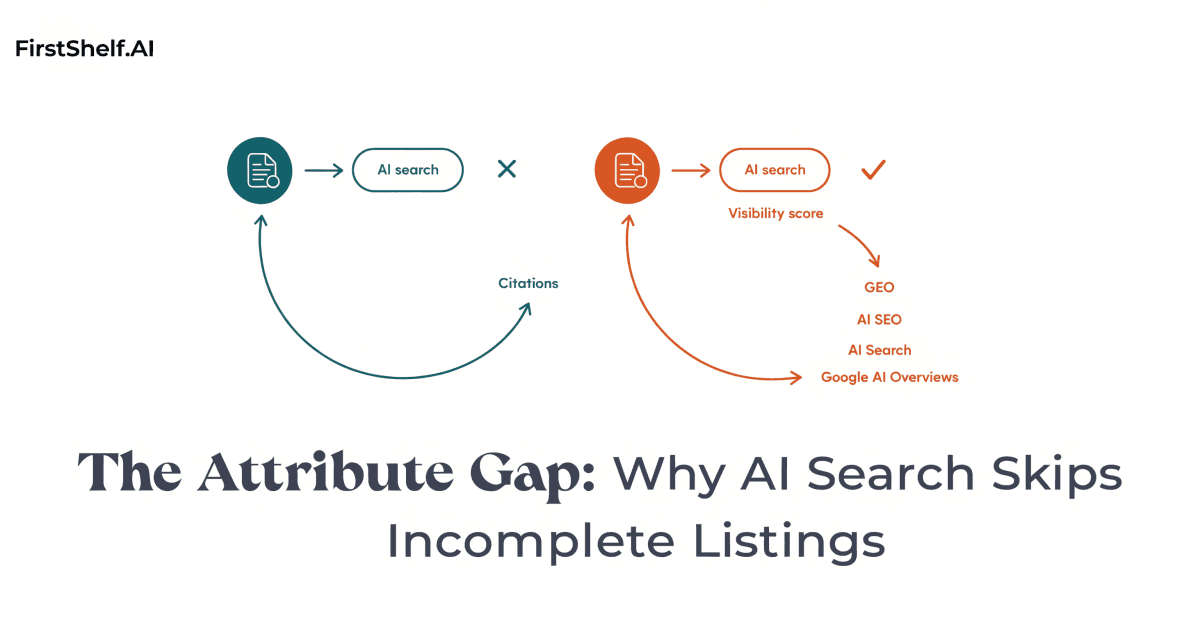
This is the attribute gap — the distance between the standard fields AI engines match on and the fields your listings actually carry.
The evidence: entity authority is your weakest signal
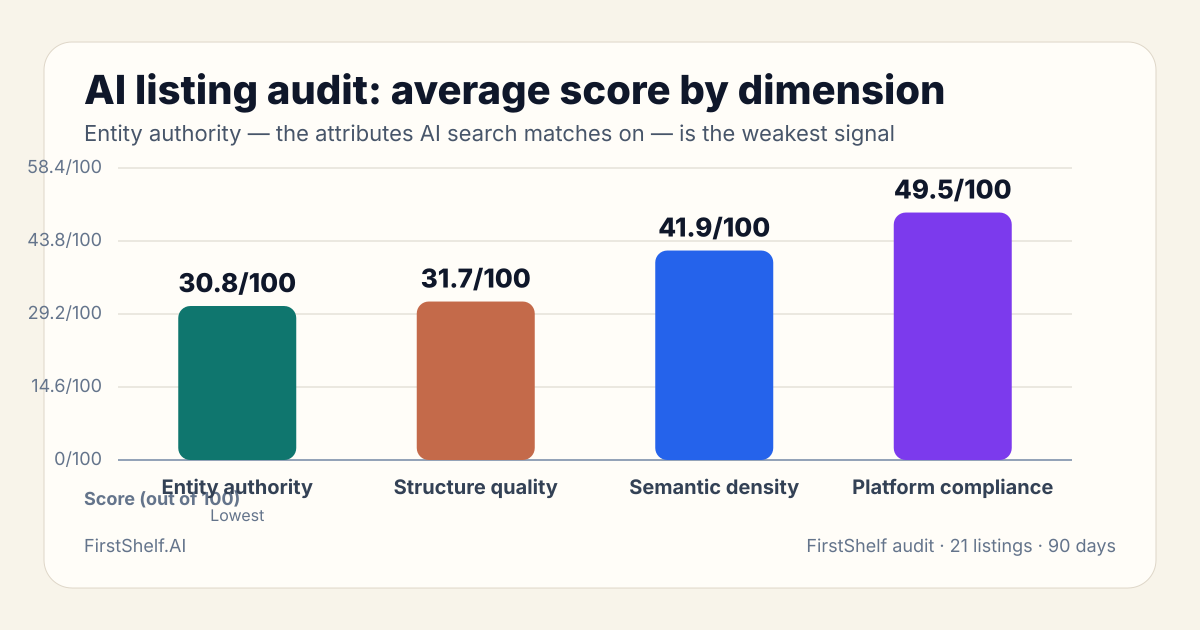
FirstShelf scores every listing across four dimensions. An anonymized audit of 21 marketplace listings over a 90-day period found that entity authority — the dimension measuring whether a listing carries the factual attributes AI engines match on — averaged just 30.8 out of 100. That was the lowest of the four dimensions, trailing platform compliance (49.5), semantic density (41.9), and structure quality (31.7).
The most commonly missing attributes were exactly the ones comparison filters depend on:
- Authenticity guarantee (missing on the most listings in the sample)
- Size and dimensions
- Software compatibility
- Editability — what can and cannot be changed
- Delivery method (download versus access)
- License or usage terms (personal versus commercial)
In plain terms, the average listing lost more than half of its possible entity-authority score before the AI ever read a sentence of its description. No amount of persuasive copy can recover a listing that the engine cannot match in the first place.
What AI shopping actually does with your attributes
Google confirms that AI Mode is “particularly helpful for queries where further exploration, reasoning, or complex comparisons are needed,” and that both AI Overviews and AI Mode may use a “query fan-out” technique — issuing multiple related searches across subtopics and data sources to build an answer.
Picture a buyer asking for running shoes under $120 in size 9 with free returns. Fan-out fires several sub-searches: one filters by price, one by size, one by availability, one by return policy, then the reasoning layer compares what survived. Every sub-search pulls on a specific attribute. A listing that never declares a size cannot survive the size-9 filter. A listing whose return policy lives only in a paragraph marked “easy returns” cannot survive a structured returns filter. Only a declared field survives a structured filter — prose never does.
This is why attribute completeness, not keyword density, is now the gatekeeper for AI shopping visibility.
The four attribute groups that decide eligibility
Google’s product data specification groups attributes into categories. Four of them decide whether a listing is matchable in AI shopping:
1. Product identifiers
Brand, GTIN, and MPN are the keys an engine uses to recognize your product as a unique entity and group it across sellers. Google’s spec notes that “your product’s category type determines which unique product identifiers (GTIN, MPN, brand) are required,” and that omitting them can disapprove a listing entirely. Without an identifier, the engine cannot confirm two sources are describing the same product, which weakens the corroborated entity profile that drives recommendations.
2. Price and availability
Price and availability are non-negotiable filters. Google’s Product structured data documentation shows that shoppers can see “price, availability, review ratings, shipping information” directly in results. A listing missing price or availability is invisible to every price-bounded and in-stock query — which is most comparison queries.
3. Variant attributes
For products sold in multiple versions, variant attributes — item group id, color, size, material — tell the engine which listings are siblings of the same parent product. Google recommends product variant structured data “to help Google better understand which products are variations of the same parent product.” Missing variant data is one of the spec’s named causes of limited eligibility, and it is the single most common reason an AI comparison shows the wrong color or size.
4. Shipping and returns
Shipping cost, speed, and return policy are the filters buyers add when they narrow a shortlist. Google recommends declaring these as structured policy data — “Share shipping costs, especially free shipping” and “Share return information, such as your return policy, fees involved in returns, and how many days customers have to return” — because shoppers weigh total cost, not sticker price. A listing that omits shipping and returns loses the final, highest-intent filter.
Why new “AI markup” is the wrong fix
The tempting response to AI search is to bolt on something new — a dedicated AI file, a chunking scheme, or a special AI-only schema. Google’s AI features guidance pushes back directly: “There’s also no special schema.org structured data that you need to add” to appear in AI Overviews or AI Mode, and “You don’t need to create new machine readable files, AI text files, or markup to appear in these features.”
The attribute gap is not a missing-markup problem. It is a completeness problem with the markup Google already documents. The Product structured data vocabulary (brand, gtin, color, size, material, offers, aggregateRating) and the Merchant Center feed attributes (gtin, mpn, color, size, shipping, returns) already describe everything an AI comparison needs. The work is filling in the fields you skipped, not inventing new ones.
Crucially, Google says some shopping experiences combine page structured data with Merchant Center feed data — “product snippets may use pricing data from your merchant feed if it’s not present in the structured data on the page.” That means the two sources reinforce each other, and a gap in one can sometimes be covered by the other. Completing both is the highest-coverage move.
Your attribute-completeness checklist
Run every listing through this checklist before it goes live:
- Declare a brand and a product identifier (GTIN where one exists, MPN and brand otherwise). If the product genuinely lacks identifiers, set the identifier-exists flag to no rather than leaving the field blank.
- Add a category using Google’s product taxonomy. A wrong or missing category is one of the spec’s named causes of limited eligibility.
- Set price and availability in the Product offer. Every comparison query filters on at least one of these.
- Declare variant attributes — item group id, color, size, material — for every version of a parent product.
- Add shipping details (cost, speed, free-shipping flag) and a return policy as structured policy data, not just as body copy.
- Fill the attributes that buyers in your category actually filter on. For digital and marketplace goods, that includes delivery method, license or usage terms, software compatibility, and what is included in the purchase — the exact fields most often missing in the FirstShelf sample.
- Keep your structured data and Merchant Center feed in agreement. Google flags conflicting data between feed and website as a top eligibility problem.
How to verify before you publish
Catching the gap before the engine does takes two free checks. Run each listing URL through Google’s Rich Results Test to confirm the Product structured data parses and that required properties are present. Then use Merchant Center diagnostics (the Issue Details Page) to surface missing or incorrect attributes at scale — it lists exactly which fields are missing, conflicting, or malformed.
Pair both with the new Generative AI performance report in Search Console, which shows which of your pages appear in AI Overviews and AI Mode. If a listing you expected to surface is absent, the attribute gap is the first place to look: a listing that fails a filter never reaches the ranking layer at all.
The takeaway
AI search did not invent a new requirement for product listings. It exposed one that was always there. Buyers have always filtered by size, price, and returns — AI simply enforces those filters automatically and at scale. The sellers who win in AI shopping are the ones who treated product attributes as data all along, not as optional decoration. Close the attribute gap, validate it, and your listings become matchable in the comparisons that now drive discovery.
How FirstShelf can help
Closing the attribute gap starts with knowing which fields your listings actually declare — and which ones an AI shopping engine silently fails to find. The free FirstShelf GEO audit reads a listing the way a structured filter does and scores it across the same four dimensions cited in the audit above, including the entity authority signal that captures brand, identifiers, variants, and policy attributes.
Where a listing falls short, FirstShelf’s listing rewriting turns buried prose — “easy returns”, “ships fast” — into the declared fields and structured claims AI systems can match on, and the dashboard tracks how your attribute completeness trends as marketplaces add new required fields. To see which attribute group is holding your listings back, run a free 60-second audit at firstshelf.ai.
See which attributes your listings are missing
The free FirstShelf GEO audit scores your listings on entity authority — the exact signal this audit found weakest.
Run a Free GEO AuditFrequently Asked Questions
What is the attribute gap in AI search?
The attribute gap is the distance between the standard product fields AI shopping engines use to match, filter, and compare products — brand, GTIN, size, color, price, shipping, and returns — and the fields your listings actually carry. When a field is missing, the engine has nothing to match on and the listing drops out of the comparison. An anonymized FirstShelf audit of 21 listings over 90 days found entity authority averaged just 30.8 out of 100 because so many of these fields were absent.
Do I need special AI schema to appear in Google AI Overviews or AI Mode?
No. Google's AI features guidance states there is no special schema.org required for AI Overviews or AI Mode, and that you do not need new machine-readable files or AI markup. The work is completing the standard Product structured data and Merchant Center feed attributes Google already documents, which also feed AI shopping comparisons.
Which product attributes matter most for AI shopping eligibility?
The four highest-impact groups are product identifiers (brand, GTIN, MPN), price and availability, variant attributes (item group id, color, size, material), and shipping and returns. Google's Merchant Center spec names missing GTINs and variant attributes as leading causes of limited eligibility, and every comparison query filters on price, size, or returns.
Why does prose like 'free returns' not work in AI search?
Structured AI filters read declared fields, not body copy, so a return policy mentioned only in a paragraph cannot survive a structured filter. Google recommends declaring shipping costs and return policies as structured policy data so shoppers can see total cost directly in results. Prose complements the field; it never replaces it.
How do I check my listings for missing attributes?
Run each listing through Google's Rich Results Test to confirm Product structured data parses with required properties present, then use Merchant Center diagnostics to surface missing, conflicting, or malformed attributes at scale. Cross-reference with the Search Console Generative AI report to see which pages actually appear in AI Overviews and AI Mode.
Glossary
- Attribute gap
- The distance between the standard product attributes an AI shopping engine uses to match, filter, and compare products (brand, GTIN, size, color, price, shipping, returns) and the attributes a listing actually declares. A wide gap means the engine cannot match the listing, so it drops out of comparisons regardless of copy quality.
- Entity authority
- A FirstShelf scoring dimension measuring whether a listing carries the factual, matchable fields AI engines rely on, such as identifiers, specifications, compatibility, license terms, and delivery method. Higher entity authority means an AI engine can confidently recognize and compare the product.
- Product structured data
- Schema.org Product markup added to a product page so search engines can read price, availability, brand, ratings, and other attributes as structured fields. Google uses it to make products eligible for richer results, Google Images, and Google Lens.
- GTIN
- Global Trade Item Number — a unique product identifier assigned by the manufacturer that lets search engines and marketplaces recognize a product across sellers and group corroborating sources. Google's Merchant Center spec requires it (or MPN plus brand) for most categories.
- Query fan-out
- A technique Google says AI Overviews and AI Mode use, where the system issues multiple related searches across subtopics and data sources to build a comprehensive answer to a complex or comparison query. Each sub-search typically pulls on a different product attribute.
Sources
- Introduction to Product structured data — Google Search Central - Google's official Product structured data guide: how product markup makes listings eligible for richer results, Google Images, and Google Lens, with properties for price, availability, ratings, shipping, and returns.
- AI features and your website — Google Search Central - Google's official guidance on appearing in AI Overviews and AI Mode, confirming no special schema.org or AI markup is required and describing the query fan-out technique used for complex comparisons.
- Product data specification — Google Merchant Center Help - Google's Merchant Center feed specification, stating Google uses product data to match products to queries and that missing or incorrect attributes (GTIN, category, variant attributes) cause limited eligibility and disapprovals.
- Product — Schema.org - The canonical Schema.org Product type, defining the standard properties AI and search engines read, including brand, gtin, mpn, color, size, material, offers, and aggregateRating.
Related Articles
Accessibility Trees: Check Your Product Page
Inspect product controls, size charts, and variant states in a browser's accessibility tree. A practical seller workflow with clear limits on what the test establishes.
6 min readAI Search Users Ask Questions, Not Keywords. Rewrite Your Listings.
Google's AI Mode data shows queries are now triple the length of traditional searches, and follow-up questions grow 40% monthly. Yet most product listings are still written for 3-word keywords. Here is how to rewrite your content for the questions buyers actually ask.
9 min read