
TL;DR & Key Takeaways
Agentic commerce moves AI search from information to transactions. In May 2026 Amazon launched Buy for Me, an agent that completes purchases on other retailers' sites, while Google announced the Agent Payments Protocol and Universal Cart for agent-driven checkout. Shopify reported AI-attributed orders up 11x since January 2025. The new seller requirement: be machine-readable and transactable — exact price and stock, complete attributes, and structured data agents can buy from.
- Prepare for agents that buy, not just cite — Amazon's Buy for Me completes purchases on other retailers' sites for eligible products, and Google's AP2 lets agents pay within shopper-set brand and spend guardrails.
- Make price and stock agent-accurate — Amazon Scheduled Actions and AP2 triggers fire on exact conditions, so a stale price silently disqualifies the purchase.
- Close the structured-attribute gap agents compare on — an anonymized FirstShelf audit of 21 listings scored entity authority at just 30.8/100, the exact layer an agent reads to match a product to a shopper's criteria.
- Optimize for marketplace AI overviews too, not just Google — Amazon now surfaces AI summaries atop its own search results, available to millions of customers.
- Let the protocols arrive through your platform — UCP, AP2, and Buy for Me are mostly platform-mediated, so keep structured data clean and ask your platform when agent checkout lands.
What agentic commerce actually means
Every AI-search article in this archive has answered one question: will the AI cite your product? Agentic commerce adds a second, harder question: will the AI buy your product for its customer?
“Agentic commerce” is the term Google and Shopify now use for transactions in which an AI agent discovers a product, compares it against alternatives, and completes the purchase on a shopper’s behalf — sometimes without the shopper ever clicking through to your store. Google calls it “the foundation for agentic commerce.” Shopify president Harley Finkelstein told investors his company is working to “lay the rails for agentic commerce.”
The shift matters because it moves AI from an information layer (who gets cited) to a transaction layer (who gets bought). For most of 2025 that was theory. In May 2026, two of the three largest shopping surfaces shipped the actual machinery.
The May 2026 inflection: agents that complete checkout
On May 13, 2026, Amazon replaced its Rufus assistant with Alexa for Shopping, which combines Rufus’s product knowledge with Alexa+ personalization. Buried in that announcement is the feature that changes seller economics: Buy for Me. For eligible products that live on other retailers’ sites, Amazon says “the Buy for Me agentic AI feature handles the entire purchase on your behalf using your primary address and credit card.” A companion feature, Shop Direct, lets shoppers “discover hundreds of millions of products in Amazon’s store and from stores across the web.” Amazon says the predecessor assistant, Rufus, helped over 300 million customers in 2025 research, compare, and buy.
Six days later, at Google I/O 2026 (May 19), Google announced its parallel rails. The Agent Payments Protocol (AP2) lets an agent “make secure payments on your behalf” once a shopper tells it “the specific brands and products you want and how much it can spend,” and “the agent only makes the purchase when your criteria are met.” AP2 uses “tamper-proof digital mandates” so the user, merchant, and payment processor share one auditable record, and it rolls out “starting with Gemini Spark.” Google paired it with the Universal Cart — an intelligent cart that follows a product across Search, Gemini, YouTube, and Gmail, hunting for price drops, flagging incompatible parts, and checking out through the co-developed Universal Commerce Protocol (UCP).
The two launches agree on one thing: the agent, not the shopper, is increasingly the one who compares and pays. The shopper sets a guardrail; the agent executes.
Is this real yet? The data says it is moving fast
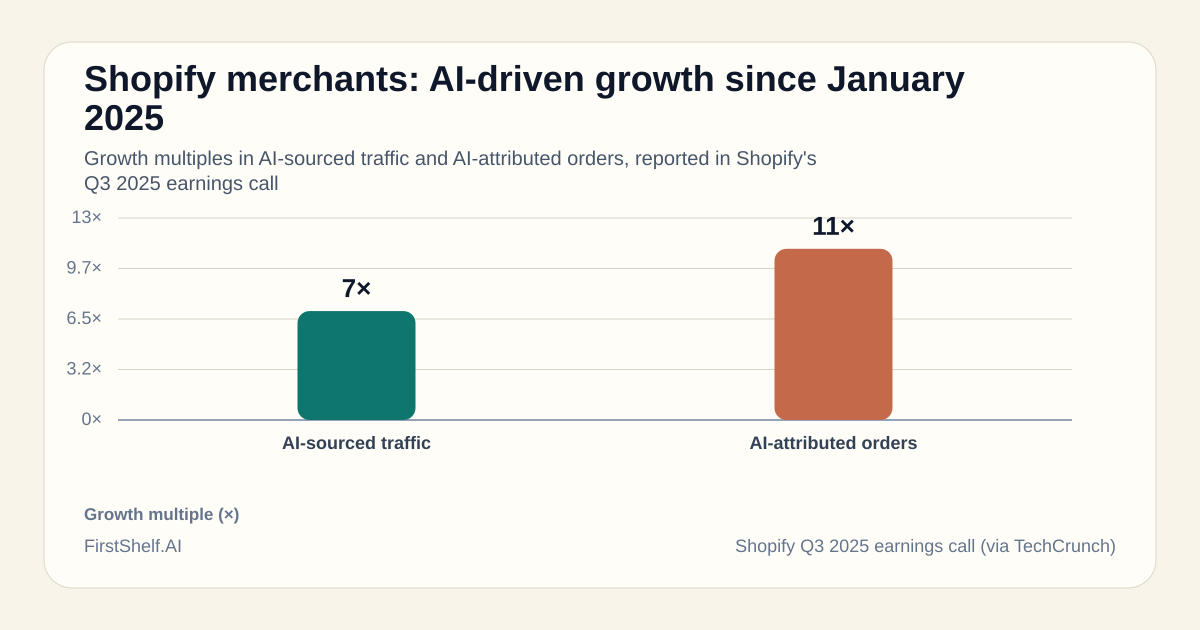
The product launches would matter less if the volume were not growing. In its Q3 2025 earnings call, Shopify reported that traffic from AI tools to its merchants’ stores was up 7x since January 2025, and purchases attributed to AI-powered search were up 11x. A Shopify survey found 64% of shoppers said they are “likely” to use AI when making purchases.
Finkelstein added the honest caveat that it is “still very, very early,” so read those multiples as growth from a small base over roughly ten months — not as settled market share, and not as proof that autonomous agents drove every one of those orders.
Google’s Shopping Graph — the catalog its agents draw from — now holds over 60 billion product listings, and the company says people “shop across Google more than a billion times a day.”
The infrastructure for agent-driven buying exists at scale. The open question is whether your products are legible to it.
Why “get cited” is no longer enough
Earlier FirstShelf articles covered how to get cited by AI Overviews, AI Mode, ChatGPT, and Perplexity. Agentic commerce exposes the limit of that playbook: a citation is an opportunity to be considered. A purchase is a completed transaction. When an agent buys, it does not read your marketing prose — it reads the structured fields it needs to compare and execute.
Three things now matter that mattered less when the only goal was citation:
Exact, real-time price and availability. Amazon’s Scheduled Actions let a shopper say, “Add this sunscreen to my cart if the price drops to $10 and I haven’t purchased it in the last 2 months.” AP2 lets a shopper cap spend and name specific brands. Both assume your price and stock data are accurate to the minute. A stale price or a wrong out-of-stock flag does not just cost a ranking — it silently disqualifies the purchase.
Comparable, complete attributes. Agents compare products on machine-readable fields — brand, GTIN, size, color, compatibility, shipping, returns — the same fields Google’s Merchant Center already uses for eligibility. An anonymized FirstShelf audit of 21 listings over 90 days scored entity authority at just 30.8 out of 100, with missing values for license and usage terms, delivery method, and editability among the most common gaps. That is precisely the layer an agent reads to decide whether your product matches a shopper’s criteria.
Transactability, not just discoverability. Google’s UCP and Amazon’s Buy for Me assume the agent can complete checkout. If your store blocks agent runtimes, gates the cart behind a login wall, or breaks on a non-human checkout flow, you can be cited and still never bought.
This is observation, not certainty. Neither Google nor Amazon has published conversion data attributing purchases specifically to autonomous agents, and you should not infer revenue from the traffic multiples above. But the direction is unambiguous: the comparison and payment steps are moving inside the agent.
What marketplace sellers should do now
You do not need to invent a new AI-specific format. Google’s own May 2026 guidance says there is no special markup required for generative AI search. What you need is completeness and machine-readiness across the layers an agent actually touches.
Treat your product feed as the storefront. Whether you sell on Amazon, through Google Merchant Center, or on your own site, the feed — brand, GTIN, price, availability, variants, shipping, returns — is what agents compare on. Close every attribute gap; an agent cannot buy what it cannot parse.
Prepare for the protocols; do not panic-build them. UCP, AP2, and marketplace equivalents like Buy for Me are still rolling out and are largely platform-mediated. If you are on Shopify, BigCommerce, or a major marketplace, the protocol plumbing will usually arrive through your platform — your job is to keep structured data clean so you are eligible when it does. Standalone sellers should ask their platform when UCP checkout lands rather than implement the spec cold.
Make price and stock agent-accurate. Because shoppers can now set conditional price triggers, your listed price and availability must match reality. A listed price of $9.99 when a trigger fires at $10 earns the sale; a $12 sticker loses it with no notification.
Optimize for marketplace AI overviews, not just Google. Amazon now surfaces AI-generated overviews at the top of its own search results and on product detail pages, “already available to millions of customers.” If you sell on Amazon, you now optimize for Amazon’s AI summary — its comparisons and recommendations — in addition to keyword rank. Google’s new Merchant Center tools (AI performance insights and conversational attributes) are built for exactly this.
Stay legible to agent runtimes. Allow the crawlers and runtimes that fetch your page, serve clean initial HTML, and do not gate checkout behind steps a non-human buyer cannot pass. The same accessibility-tree and structure fixes that earn AI citations also let an agent finish a purchase.
How FirstShelf can help
Agentic commerce rewards sellers whose listings are complete, comparable, and machine-readable — the exact signals FirstShelf audits. FirstShelf scores your product data the way an agent reads it: entity authority, structure quality, and attribute completeness, so you can see the gaps an agent would silently disqualify you for before a competitor’s cleaner feed wins the purchase. Run an audit, fix the fields that block agent comparison, and track whether your listings stay eligible as the protocols roll out.
Find out if an agent could buy from you
FirstShelf audits your listings the way an AI agent reads them — entity authority, structure, and attribute completeness — so you can close the gaps that silently disqualify a purchase.
Audit my listingsFrequently Asked Questions
Do I have to build UCP or AP2 integration myself?
Mostly no. If you sell on Shopify, BigCommerce, a major marketplace, or use Google Merchant Center, the protocol plumbing arrives through your platform. Your job is to keep your structured data complete so you are eligible when agent checkout switches on. Standalone sellers should check with their platform rather than implementing the spec from scratch.
Does Amazon Buy for Me compete with my own website?
It means Amazon's agent can complete purchases on third-party sites for eligible products. If your products surface through Shop Direct, the agent may buy directly from you. Being agent-readable is an opportunity, not a threat — but only if your listing data is clean enough for the agent to compare and transact.
Is agentic commerce live today or still future?
The building blocks are live and growing fast — Shopify reported AI-attributed orders up 11x since January 2025. But fully autonomous agent checkout (Google AP2, Amazon Buy for Me) is rolling out through 2026 and is limited to eligible products and participating merchants. Treat it as real and early.
Glossary
- Agentic commerce
- Transactions in which an AI agent discovers, compares, and purchases a product on a shopper's behalf, sometimes without the shopper clicking through to the seller's store.
- Agent Payments Protocol (AP2)
- Google's protocol that lets an AI agent make secure payments within guardrails a shopper sets (specific brands, products, and spending limits), using tamper-proof digital mandates.
- Universal Commerce Protocol (UCP)
- An open protocol Google co-developed with retailers to standardize agent-driven checkout and product-data exchange across merchants.
- Buy for Me
- Amazon's agentic feature that completes an entire purchase on a third-party retailer's site using the shopper's saved address and payment card, for eligible products.
Sources
- Google — Introducing the Universal Cart and more ways to help you shop - Official Google I/O 2026 announcement of Universal Cart, AP2, and the 60-billion-listing Shopping Graph.
- Google — Helping retailers thrive with new UCP features and AI tools - Official Google Marketing Live announcement of UCP retailer tools: AI performance insights, conversational attributes, Ask Advisor, Direct Offers.
- Amazon — Meet Alexa for Shopping - Official Amazon announcement of Alexa for Shopping, Buy for Me, Shop Direct, Scheduled Actions, Price History, and AI overviews in Amazon search.
- TechCrunch — Shopify says AI traffic is up 7x, AI-driven orders up 11x - Shopify Q3 2025 earnings-call data on AI-sourced traffic and AI-attributed order growth, plus the 64% shopper survey.
- FirstShelf — anonymized listing audit (firstShelfSignals) - Anonymized FirstShelf audit of 21 listings over 90 days; entity authority scored 30.8/100 with common missing structured fields.
Related Articles
Agent Readiness Scores: What Actually Matters
Cloudflare's Agent Readiness Scanner scores websites on 16 signals across 5 categories. But the composite number is misleading. Here's what actually matters for making your site legible to AI agents — and what Google says you can skip.
8 min readChatGPT Product Ads vs Organic Discovery
OpenAI now documents a hard beta boundary: Ads Manager feeds make products ad-eligible, not organically discoverable. Organic shopping uses separate data paths.
5 min readThe Attribute Gap: Why AI Search Skips Incomplete Listings
AI shopping engines filter and compare products by structured attributes — brand, GTIN, size, shipping, returns — not keywords. An anonymized FirstShelf audit of 21 listings found entity authority scored just 30.8 out of 100. Here is how to close the attribute gap.
7 min readAI Overviews for Ecommerce: Seller Playbook
AI Overviews are no longer just for informational searches. Semrush data shows they've shifted from 89% to 57% informational — your product pages are now competing with AI summaries. Here's the updated visibility playbook.
7 min read