
TL;DR & Key Takeaways
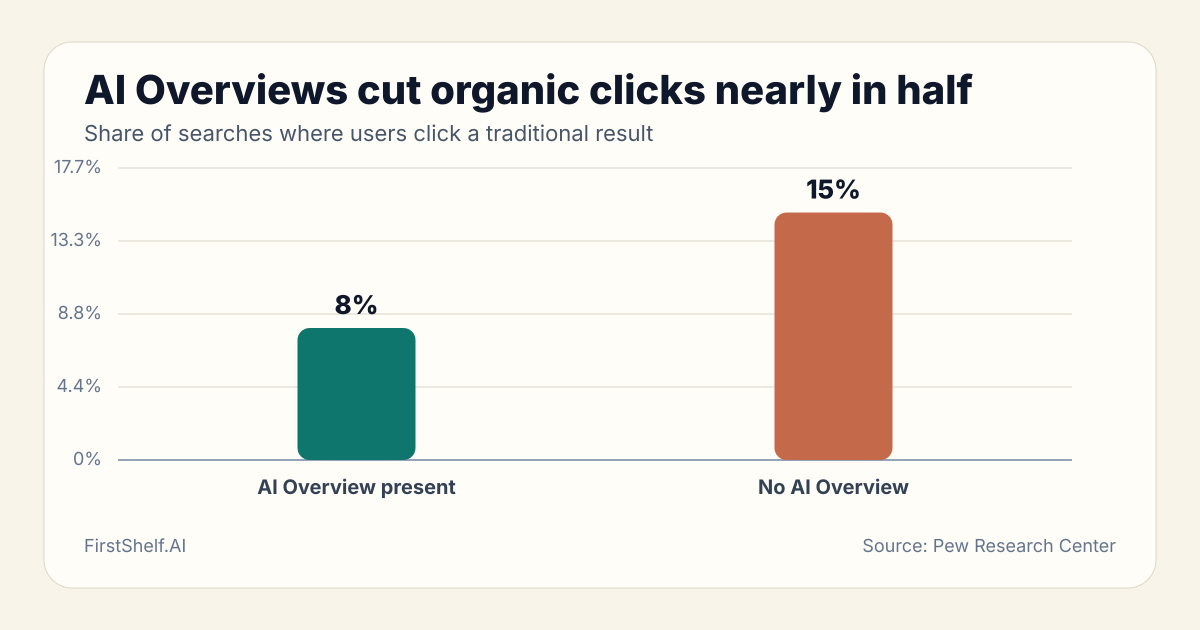
Google's AI Overviews have shifted from mostly informational queries to commercial and product-related ones. Semrush data shows the share of informational keywords triggering AI Overviews dropped from 89% in October 2024 to 57% by October 2025. With Pew Research finding users click traditional results just 8% when an AI Overview is present, product sellers must pivot from chasing clicks to earning AI citations through structured data, entity signals, and citation-ready content.
- Audit every product page's structured data for completeness — include brand, GTIN, MPN, aggregateRating, and full Offer details to give AI models the confidence signals they need to cite your products.
- Rewrite product descriptions as self-contained, citation-ready passages that address what the product is, who it's for, how it compares, and what reviewers say — because AI Overviews extract individual sections, not full pages.
- Build third-party brand mentions across review sites, blogs, and forums — the original GEO research demonstrated that optimization techniques can boost AI visibility by up to 40%, and entity recognition depends heavily on external signals.
- Optimize for query fan-out by creating FAQ sections and supporting content that covers the constellation of sub-queries AI Overviews trigger, not just the primary keyword.
- Track AI-specific metrics — citation rate, share of AI voice, and query coverage — separately from traditional SEO rankings, because clicks and rankings no longer tell the full story of your search visibility.
The AI Overview Shift That Changes Everything for Product Sellers
If you sell products online, the most important Google update of 2025 wasn’t an algorithm change — it was a behavioral shift in what triggers AI Overviews.
For months, Google’s AI-generated summaries were mostly an informational play. You’d see them for “how does photosynthesis work” or “what is machine learning.” They were interesting, but they didn’t threaten ecommerce traffic directly.
That changed fast.
According to Semrush Sensor data, the percentage of informational keywords triggering AI Overviews dropped from 89.03% in October 2024 to just 57.16% by October 2025. The gap — now roughly 43% of AI Overview triggers — is filled by navigational, commercial, and transactional queries. That means product comparisons, “best of” lists, pricing lookups, and buying guides.
In plain terms: Google’s AI is now answering the exact queries your customers used to click through to your product pages for.
What the Data Actually Shows
Here’s what the research from Semrush and Pew Research Center tells us about the current state of AI search:
- AI Overviews now appear for approximately 12.95% of search queries in the U.S. market on average, according to Semrush Sensor’s ongoing analysis of millions of keywords.
- Users click traditional organic results just 8% of the time when an AI Overview is present, compared to 15% when there’s no AI Overview — a finding from Pew Research Center.
- Users click links within the AI Overview itself only about 1% of the time. That means even when your brand is cited in the AI answer, the direct click-through is minimal.
- AI Overviews use a technique called query fan-out, where Google’s system runs multiple related searches simultaneously to synthesize a comprehensive answer. A single query like “best running shoes for flat feet” might trigger sub-queries about arch support, durability, price comparisons, and podiatrist recommendations.
Google itself states that its recommendation for optimizing for AI features is to “apply the same foundational SEO best practices for AI features as you do for Google Search overall,” as documented in their Search Central documentation.
But “foundational SEO” means something very different when the goal is being cited by an AI rather than being clicked by a human.
Why This Is Different From Traditional SEO
The old SEO contract was simple: rank high, get clicks, convert visitors. AI Overviews break that contract in three ways:
1. Zero-click answers eliminate the middleman. When Google’s AI says “The best CRM for small businesses is HubSpot, followed by Zoho and Salesforce,” the user often gets what they need without clicking anything. Your product page doesn’t even get a chance to make its case.
2. Citations replace rankings. In AI Overviews, being cited as a source matters more than your position on the page. The AI pulls from multiple sources, synthesizes them, and presents a unified answer. Your goal is to be one of those sources — ideally the primary one.
3. Query fan-out multiplies the surface area. Because Google’s AI runs multiple sub-queries for complex questions, your content needs to address not just the main query but the related sub-queries too. A product page optimized for “ergonomic office chair” also needs to cover posture benefits, lumbar support comparison, price-to-value analysis, and assembly complexity — because the AI might check all of those.
The Structured Data Advantage
This is where structured data becomes your single most important technical asset for AI visibility. Google’s Product structured data documentation specifies the properties that help Google understand your products — and those same properties feed the AI models that generate AI Overviews.
Here’s what a citation-ready Product schema looks like:
For a citation-ready Product schema, make sure each product page exposes these fields in clean JSON-LD:
- Product identity: name, description, image, brand, GTIN, and MPN where available.
- Offer data: URL, price, currency, availability, and seller details.
- Trust signals: aggregateRating with both ratingValue and reviewCount, plus review data when it is accurate and eligible.
- Entity consistency: the same brand, product identifiers, and offer details that appear visibly on the page.
These fields give Google’s AI machine-readable signals about what your product is, who makes it, what it costs, and whether buyers trust it. When the AI is deciding which products to include in its generated answer, these signals act as confidence markers.
Google’s structured data documentation recommends including all required and recommended properties for the Product type to maximize eligibility for search features — and by extension, AI Overviews.
Five Action Steps for Product Sellers
1. Audit Your Product Schema for Completeness
Most ecommerce product pages have basic structured data — a product name, price, and maybe an image. But the AI models need more context to cite you with confidence.
Check every product page for:
- Brand property with proper Brand type nesting
- GTIN and MPN identifiers where available
- AggregateRating with both ratingValue and reviewCount
- Offer details including availability status
- Description that’s factually rich, not marketing fluff
Use Google’s Rich Results Test to validate your schema, then cross-reference against the Product type specification on Schema.org.
2. Write Citation-Ready Product Descriptions
AI Overviews don’t pull marketing copy. They pull factual, specific statements that answer the sub-queries generated by query fan-out.
For each product, make sure your description addresses:
- What it is — category, materials, key specifications
- Who it’s for — use cases, target audience, common scenarios
- How it compares — positioning relative to alternatives (without naming competitors directly)
- What reviewers say — aggregate sentiment and specific praise points
- What it costs and why — value proposition tied to features
Structure these as self-contained paragraphs that an AI could extract independently. Each paragraph should make sense on its own, because that’s exactly how AI Overviews consume and republish your content.
3. Build Third-Party Brand Mentions
The original GEO research paper from Princeton University demonstrated that Generative Engine Optimization techniques can boost content visibility by up to 40% in AI-generated responses. One of the strongest signals? Mentions of your brand on third-party websites.
AI models learn about entities — products, brands, people — from the broader web, not just your own site. If your product is mentioned in buying guides, review roundups, blog posts, and forum discussions across multiple authoritative domains, the AI is more likely to recognize your brand as a legitimate entity worth citing.
Tactical moves:
- Get your products listed in independent review roundups and comparison articles
- Respond to media requests on platforms like HARO and Featured to earn expert mentions
- Encourage customers to leave reviews on third-party platforms (not just your own site)
- Create shareable data, original research, or unique angles that give journalists a reason to reference you
4. Optimize for the Fan-Out, Not Just the Query
Because AI Overviews use query fan-out to run multiple sub-queries, your content strategy needs to cover the constellation of related questions — not just the primary keyword.
If you sell “organic dog treats,” the AI might fan out to:
- Are organic dog treats healthier than conventional ones?
- What ingredients should I avoid in dog treats?
- What’s the price difference between organic and standard dog treats?
- Which brands do veterinarians recommend?
Create content that addresses each of these sub-queries — either on your product pages (in FAQ sections) or on supporting blog posts that link back to your products. The more of the fan-out you cover, the more likely the AI is to cite you as a comprehensive source.
FAQPage schema is particularly effective here. It gives you a structured way to present question-answer pairs that AI Overviews can extract directly.
5. Track Your AI Visibility Separately From Traditional SEO
Traditional SEO tools track rankings and clicks. AI visibility requires different metrics:
- Citation rate: How often does your brand or product appear in AI-generated answers for relevant queries?
- Share of AI voice: When the AI recommends products in your category, what percentage of mentions do you capture versus competitors?
- Sentiment of citation: When cited, does the AI frame you positively, neutrally, or negatively?
- Query coverage: Across the full fan-out of related queries, how many do you appear in?
This is exactly the gap that FirstShelf.AI was built to address — giving product sellers the ability to monitor and improve their visibility specifically within generative AI platforms, not just traditional search.
The Bigger Picture: From Clicks to Citations
The shift from informational to commercial AI Overviews isn’t a temporary phase — it’s the trajectory. Google is investing heavily in its Shopping Graph and integrating product data with AI Overviews and AI Mode. The direction is clear: more product discovery will happen inside AI-generated answers, not only on traditional result pages.
The sellers who thrive in this environment won’t be the ones with the best backlink profiles or the most keyword-stuffed pages. They’ll be the ones whose products are the most legible to AI — structured, cited, mentioned, and recognized as entities across the web.
The data is clear: clicks are declining, but citations are growing. The question isn’t whether to optimize for AI-generated answers — it’s how fast you can make the shift.
Match the playbook to your selling platform
Owned stores and marketplaces expose different controls. Shopify sellers can work through the Shopify product GEO guide, while Etsy and other marketplace sellers should start with the marketplace seller GEO guide before applying website-level schema or feed advice they may not be able to implement.
How FirstShelf can help
Every step in this playbook — schema completeness, citation-ready descriptions, fan-out coverage — starts with knowing where your listings fall short today. The free FirstShelf GEO audit reads your listing the way an AI Overview’s retrieval layer does and scores it on semantic density, structure quality, entity authority, and platform fit, so you can see in 60 seconds which of the five action steps will move the needle most.
From there, FirstShelf’s listing rewriting produces the self-contained, quotable passages AI Overviews extract, and the dashboard tracks your AI visibility separately from traditional rankings — exactly the split measurement this shift demands. Run a free audit at firstshelf.ai before your category’s commercial queries get answered without you.
Stay in the answer when the clicks disappear
FirstShelf scores your listings on the signals AI Overviews cite — and shows you what to fix first.
Run a Free GEO AuditFrequently Asked Questions
What percentage of Google searches now show AI Overviews?
According to Semrush Sensor data, AI Overviews currently appear for approximately 12.95% of search queries on average in the U.S. market. This percentage has been growing steadily as Google expands the feature to more query types, particularly commercial and transactional ones.
Do AI Overviews appear for product and shopping queries?
Yes, and increasingly so. Semrush research shows the share of informational keywords triggering AI Overviews dropped from 89.03% in October 2024 to 57.16% by October 2025, meaning commercial, navigational, and transactional queries — including product comparisons and buying guides — now make up roughly 43% of AI Overview triggers.
How does query fan-out affect my product pages?
Query fan-out means Google's AI runs multiple related searches for a single user query. If someone searches 'best ergonomic chair,' the AI might also check queries about lumbar support, price comparisons, durability reviews, and assembly difficulty. Your content needs to address these sub-queries to be cited — either on your product page or through linked supporting content.
What structured data properties matter most for AI Overviews?
For product pages, the most impactful properties are brand (with proper Brand type), GTIN, MPN, aggregateRating (with ratingValue and reviewCount), and complete Offer details including price and availability. These give AI models machine-readable confidence signals about your product's identity, pricing, and trustworthiness.
How is optimizing for AI Overviews different from traditional SEO?
Traditional SEO focuses on ranking high to earn clicks. AI Overview optimization focuses on being cited as a source in AI-generated answers. The key differences are: structured data completeness matters more than backlinks, entity recognition across the web matters more than on-page keyword density, and citation-ready content formatting matters more than meta tag optimization.
Glossary
- AI Overviews
- AI-generated summaries that appear at the top of Google search results for certain queries, powered by Google's Gemini models. They synthesize information from multiple web sources and present a direct answer, often reducing the need for users to click through to individual websites.
- Query Fan-Out
- A technique used by Google's AI where a single user query triggers multiple related sub-queries that are run simultaneously. The AI then synthesizes the results into a comprehensive answer. For example, 'best running shoes' might trigger sub-queries about arch support, durability, and price comparisons.
- Product Structured Data
- Machine-readable markup (typically JSON-LD) added to product pages that tells search engines and AI models exactly what a product is, its price, availability, brand, ratings, and identifiers like GTIN and MPN. This structured data is a key signal for appearing in AI-generated shopping answers.
- Share of AI Voice
- The percentage of AI-generated mentions or citations your brand captures within a product category, relative to competitors. Unlike traditional market share, this metric measures your visibility specifically within AI-generated answers across platforms like Google AI Overviews, ChatGPT, and Perplexity.
- Zero-Click Search
- A search result where the user gets their answer directly on the search page — through an AI Overview, featured snippet, or knowledge panel — without clicking through to any website. AI Overviews have significantly increased the prevalence of zero-click searches, particularly for commercial and product queries.
Sources
- Semrush: AI Overviews — What Are They & How to Optimize for Them - Comprehensive guide with Semrush Sensor data showing AI Overviews appear for ~12.95% of queries, and the informational-to-commercial shift from 89.03% to 57.16% between October 2024 and October 2025.
- Pew Research Center: Google Users Are Less Likely to Click When an AI Summary Appears - Primary research on Google AI summary behavior, including the 8% traditional-result click rate when an AI summary appears versus 15% without one.
- Google Search Central: AI Features and Your Website - Google's official documentation on how AI features including AI Overviews interact with website content, with guidance on foundational SEO best practices.
- Google Search Central: Product Structured Data - Technical documentation for implementing Product schema markup, including required and recommended properties for maximum eligibility in search features.
- GEO: Generative Engine Optimization (Aggarwal et al.) - The foundational Princeton University research paper that coined Generative Engine Optimization, demonstrating up to 40% visibility improvement through GEO techniques.
- Schema.org Product Type - The official Schema.org specification for the Product type, listing all available properties for structured product data.
Related Articles
AI SEO 2026: Cite Shopify Listing Fields
AI SEO for a Shopify seller is not a blog playbook. It is Title, Description, category metafields, variants, and policies written so an assistant can quote the product without guessing.
6 min readGEO vs SEO vs AI SEO: The Product Playbook
Search is shifting from clicking links to getting direct answers. Discover the critical differences between GEO, SEO, and AI SEO, and why optimizing for AI engines is the ultimate strategy for product visibility.